This week, I have commented on the following blogs by the name they were given on the class website;
http://ashtoncodybc.blogspot.com/
http://brooked518.blogspot.com/
http://crmgeo.blogspot.com/
http://szymanskirobert.wordpress.com/
http://pearlrose91.wordpress.com/
Thursday, October 4, 2012

Wednesday, October 3, 2012
Irish Geology!!!!
I don't want to give too much away about what I like, but it's just one of those reoccuring things with me. I love Ireland. I love that island country with it's deep Celtic history, myths, and just it's natural beauty in general. And now I want to learn about some of it's most famous geological land marks. What better topic to pick than the famous Giant's Causeway? I've seen recreations and artist depictions like in the movie How To Train Your Dragon, but what's the real land mark like? Why do they even call it the Giant's Causeway? So I took a beeline on Google and went to it's very own website at www.giantscausewayireland.com/. (all info mentioned is on the site!) Like all geologic land marks, it had to have been first drawn and documeted, which happended in 1693, and then first drawn in 1740. Here's a map from the site:  So, all the way on the northern coast line is this massive assemblage of basalt hexagonial structures, jutting out of the coast and leading down towards the sea. The local geologist state that it was formed over 50-60 million years ago, and there are over 40,000 of these columns! They were said to be "formed during the Tertiary Period of the earth's evolution," due to "repeat outpourings of volcanic basalt." No wonder that call it the Eighth Wonder of the World!!! And now, because I love old Celtic legends, here is a brief tale about Giant's Causeway (from the website, and could count as a first-hand geologic record...):
Finn McCool, (yes, that's his name)or Fion Mac Cumhaill, a reknown hunter/warrior figure in Irish mythology, decided to go to Scotland, but decided to rest before his journey. When he awoke, he saw a Scottish giant called Benadonner coming up on the horizon. He realized that Benadonner was a whole lot bigger than himself, and went to his wife Oonagh for advice. She disguised him as a child curled up in a cradle, making the giant afraid of how big and powerful the father would be, so he ended up returning from whence he came, destroying the Causeway in the process. It was actually said that Finn made the Causeway as stepping stones to Scotland. Sadly, it's not true, unless Finn lived 60 million years ago!
Moving towards the detailed formation of the Causeway, the website states that over "65 million years ago, the last supercontinent, Laurasia, began to fragment," which, in turn formed "volcanic activity along the mid oceanic edges," one of them " running along the present Irish Sea." " White Limestone was being deposited" during "the earlier Cretaceous period 144-65 million years ago." Near the end of the Cretaceous period, there were "periods of uptift and erosion," leading to lava flows and even creation a "lava plateau." "the first basalts to erupt at the Causeway were exposed to the weather, thus producing the thin/red brown inter-basaltic beds of weathered basalt before being buried by the next eruption." So, after a few more periods of uplift and eruption, exposing and burying basalts, the way the columns formed was by the way the lava flows cooled. When lava drained into the valleys, making that lava plateau, they cooled very slowly, and "deveolped regular patterns which went through the depth of flow." They "formed evenly spaced cooling cracks," creating those amazing columns. Both the real, and mythical story about how this geologic wonder was created are both pretty fascinating, wouldn't you say?And now, here's a pretty picture from sharewonders.com:
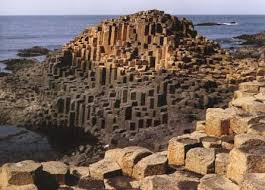
So, all the way on the northern coast line is this massive assemblage of basalt hexagonial structures, jutting out of the coast and leading down towards the sea. The local geologist state that it was formed over 50-60 million years ago, and there are over 40,000 of these columns! They were said to be "formed during the Tertiary Period of the earth's evolution," due to "repeat outpourings of volcanic basalt." No wonder that call it the Eighth Wonder of the World!!! And now, because I love old Celtic legends, here is a brief tale about Giant's Causeway (from the website, and could count as a first-hand geologic record...): Finn McCool, (yes, that's his name)or Fion Mac Cumhaill, a reknown hunter/warrior figure in Irish mythology, decided to go to Scotland, but decided to rest before his journey. When he awoke, he saw a Scottish giant called Benadonner coming up on the horizon. He realized that Benadonner was a whole lot bigger than himself, and went to his wife Oonagh for advice. She disguised him as a child curled up in a cradle, making the giant afraid of how big and powerful the father would be, so he ended up returning from whence he came, destroying the Causeway in the process. It was actually said that Finn made the Causeway as stepping stones to Scotland. Sadly, it's not true, unless Finn lived 60 million years ago!
Moving towards the detailed formation of the Causeway, the website states that over "65 million years ago, the last supercontinent, Laurasia, began to fragment," which, in turn formed "volcanic activity along the mid oceanic edges," one of them " running along the present Irish Sea." " White Limestone was being deposited" during "the earlier Cretaceous period 144-65 million years ago." Near the end of the Cretaceous period, there were "periods of uptift and erosion," leading to lava flows and even creation a "lava plateau." "the first basalts to erupt at the Causeway were exposed to the weather, thus producing the thin/red brown inter-basaltic beds of weathered basalt before being buried by the next eruption." So, after a few more periods of uplift and eruption, exposing and burying basalts, the way the columns formed was by the way the lava flows cooled. When lava drained into the valleys, making that lava plateau, they cooled very slowly, and "deveolped regular patterns which went through the depth of flow." They "formed evenly spaced cooling cracks," creating those amazing columns. Both the real, and mythical story about how this geologic wonder was created are both pretty fascinating, wouldn't you say?And now, here's a pretty picture from sharewonders.com:
Sunday, September 16, 2012
Ocean life may have already been extinct before meteor fallout kills the dinosaurs?!?!
Science Daily.com is a great place to find anything recent about anything scientific. Which is great, considering the daily news probably only shows the extremely monumental things like finding a new haplorrhine that may be on the same branch as homo sapiens sapiens or finding a new dinosaur nobody's ever seen. On September 5th 2012, a UW doctoral students named Thomas Tobin found out from ancient seashells and clams found on the ocean floor (or what was) around Seymour Island near Anartica (dating 300,000 years before the infamous meteor impact in the Yucatan Pennisula in 65 MYA). The sea life was apparently dying out before the nuclear-like fallout that the meteor caused, and they were dying because of volcanic eruptions on the Deccan Plateau in India.Tobin states these eruptions probably lasted over 100,000 years, scorching the oceanic crust and boiling those clams and snails alive. And the enormous eruptions let loose a plethora of fine particles called aerosols into the air, that cooled the planet, but also released carbon dioxide that created a long term warming period. We're worrying about the O-zone now? Think of what those clams and dinosaurs had to deal with!!! Tobin states that these aerosols only are active on a 10 year scale, while carbon dioxide is active for thousands!!! How does he know this? Tobin and a bunch of other researchers went to Seymour Island and took surface core samples and utilizing magnetostratigraphy to find changes in the magnetism over time and when the fossils were deposited. This is only a theory, but a theory in the making. Find the story here: http://www.sciencedaily.com/releases/2012/09/120905154314.htm
Sunday, September 2, 2012
Curiosity scans its first Martian rock!! Yay!!
Hello fellow geology enthusiasts! So I was browsing around the NASA website trying to find stuff on the Mars missions, when I came across the Curiosity rovers accomplishments. Well, I am one of those hopeful people that think we should plan out full on missions to sectors near our planet to find Goldilocks planets and ect., but money is an issue with discovery so I'll just have to settle for this: Apparently while on it's way up to Mt. Sharp on Mars, it encountered it's first Martian rock (creatively named N165) to scan with it's chemistry scanner, called ChemCam. This camera will be shooting lasers at the rock and will be sending information about the types of properties N165 has: it will react to the ionized gas that surrounds the rock and it will send this through a telescope to try to find out what elements it has. Just imagine, finding out if Mars once was a prime place for organic life, or that it's earth and minerals might be like those on Earth, or something we've never encountered before!! Here's the URL so you guys can check out the pictures Curiosity has sent and be excited with me!! http://www.nasa.gov/mission_pages/msl/multimedia/pia16073.html
Subscribe to:
Posts (Atom)